
Hilo Shuffle: call higher or lower on every card
One card is face up. The next one decides the round. Hilo turns a single yes-or-no read into a multiplier ladder you can keep climbing — or bank before the deck turns on you. This is the full breakdown of how the game behaves on Shuffle.
Hilo on Shuffle at a glance
Everything the game asks of you fits on one screen: a card, two calls, a running multiplier and a bank button.
Single deck ranking
Ranks run from the two up to the ace. Suits never affect the outcome — only the rank of the next card matters.
Two calls per round
Higher or lower, priced separately. The riskier side always carries the bigger multiplier of the two.
Compounding ladder
Correct calls multiply into each other, so three modest calls can outrun one long shot.
Instant settlement
Rounds resolve the moment the card lands, and balances move in crypto without a pending queue.
How a Hilo round actually plays out
The loop is short by design. You never wait on other players, there is no dealer turn and nothing is hidden behind a table minimum. What you are really doing is repeatedly pricing one question: given this card, which side of the deck is bigger?
The base card appears
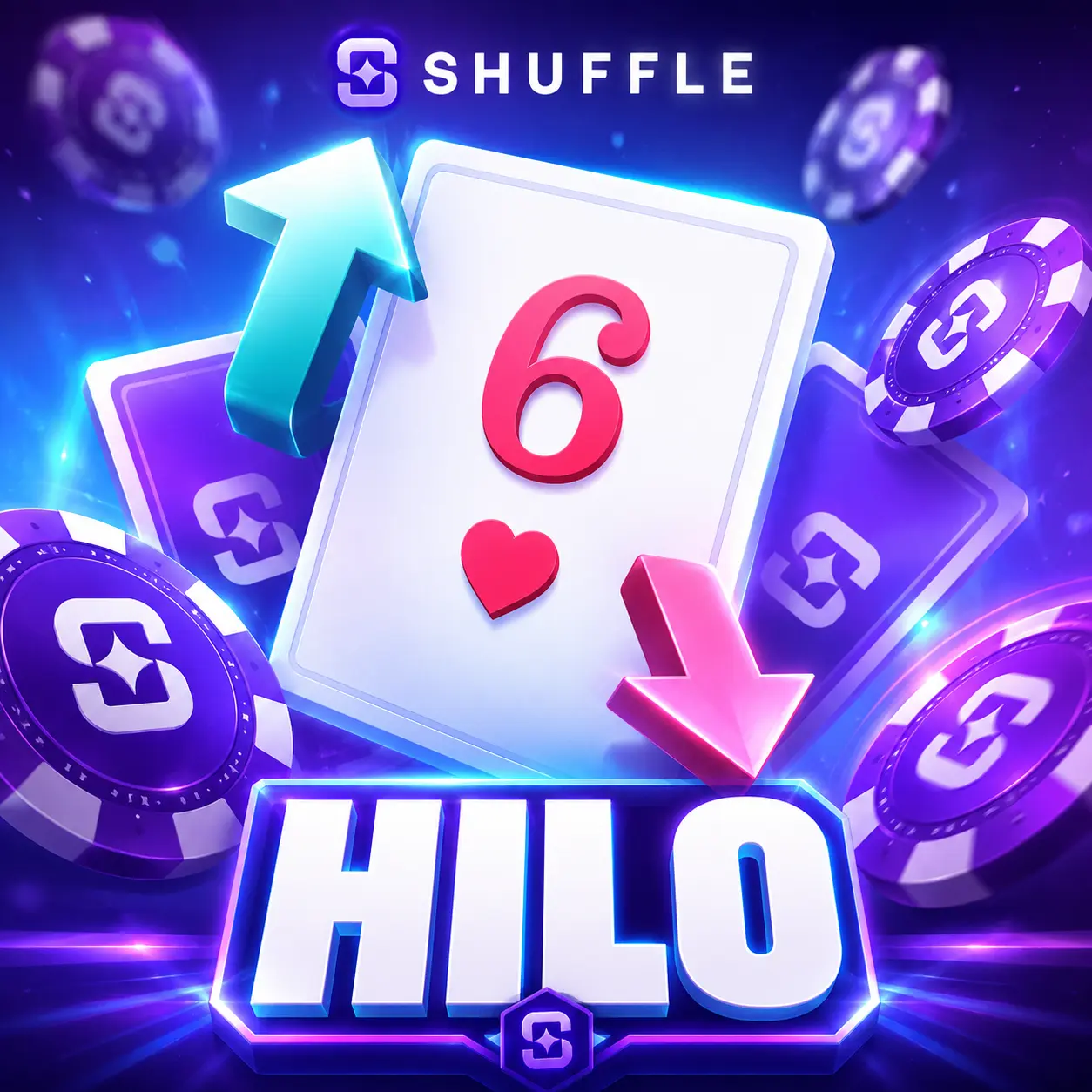
A single card is dealt face up. Its rank sets the odds for both calls before you touch anything.
Both sides get priced
Higher and lower each show their own multiplier. On a seven the two are nearly level; on a queen they are far apart.
You make the call
Pick a side and the next card flips immediately. A matching rank resolves in favour of the call that includes equals.
Climb or bank
A correct call folds its multiplier into the running total and the new card becomes the base card. Bank whenever you like — a wrong call ends the ladder.
Where the multipliers come from
Nothing about Hilo pricing is arbitrary. Each call is worth roughly one divided by its chance of landing, with a small margin held back. Read the card, count the ranks that win, and you already know the shape of the payout.
| Base card | Ranks winning "higher" | Higher pays | Lower pays | Read |
|---|---|---|---|---|
| 2 | 13 of 13 | 1.01x | 12.87x | The floor. Higher is almost free, lower is a lottery ticket. |
| 5 | 10 of 13 | 1.29x | 3.22x | Comfortable climbing territory. |
| 8 | 7 of 13 | 1.84x | 1.84x | The pivot. Both calls sit at the same price. |
| J | 4 of 13 | 3.22x | 1.29x | Mirror of the five, in the other direction. |
| A | 1 of 13 | 12.87x | 1.01x | The ceiling. Only a second ace saves the higher call. |
Figures follow the standard thirteen-rank structure with the tie resolving in favour of the call that includes equal ranks. Check the live table on Shuffle before you stake, since the interface always shows the exact price attached to each button.
Higher or lower? Let the rank decide
The whole game reduces to one number: how many ranks sit above the card in front of you. Six ranks above a nine means the higher call wins less than half the time — and gets paid accordingly. There is no memory in the deck between rounds, so a run of low cards tells you nothing about the next flip.
- Two through five — the higher call is the obvious side, but it barely moves the ladder.
- Six through nine — the flat zone. Both calls are priced close together and the choice is nearly a coin flip.
- Ten through ace — the lower call becomes the safe side and the higher call turns into a genuine long shot.
That symmetry is what makes the game readable. Once you can price a card at a glance, you stop guessing and start deciding how much variance you actually want.
Hilo inside the wider Shuffle casino lobby
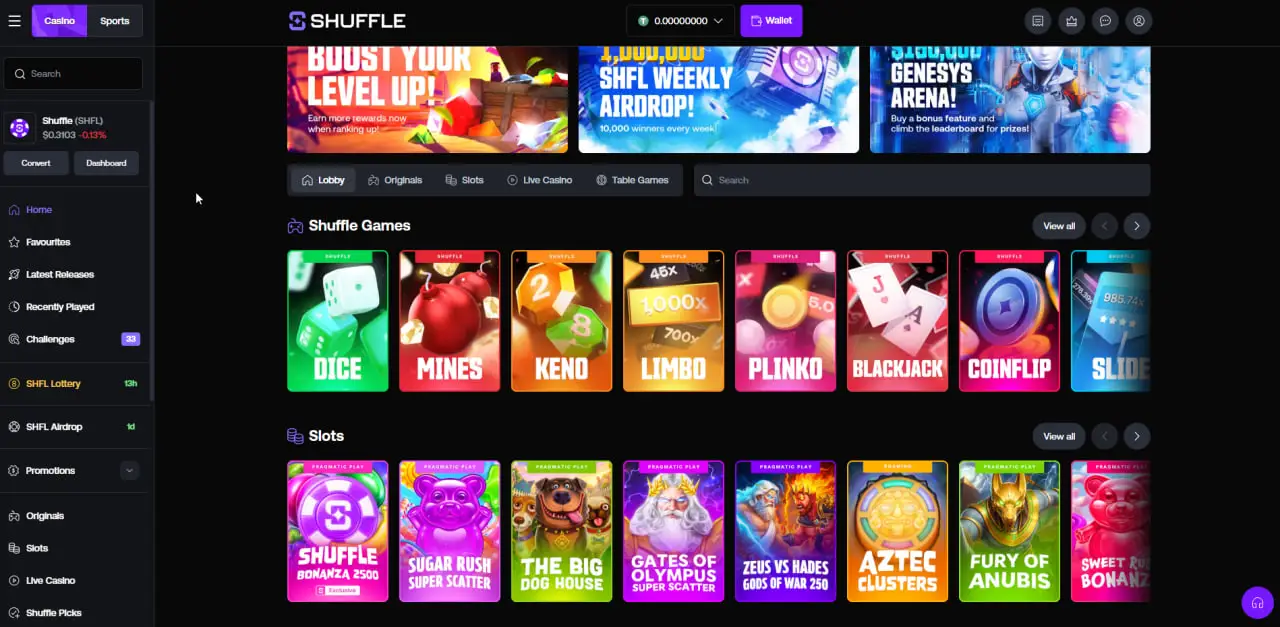
Hilo does not sit on its own. It lives in the Shuffle Originals row alongside Dice, Mines, Plinko, Limbo and Keno — the in-house titles built around provably fair round results rather than licensed slot maths. The same balance carries across all of them, so a Hilo ladder and a Plinko drop draw from one wallet.
The rest of the shuffle casino floor is a conventional crypto lobby: thousands of third-party slots, live dealer tables and a sportsbook. What keeps Hilo players in the Originals section is the round length. A slot spin is a fixed outcome; a Hilo ladder is a sequence of decisions you control from the first card to the moment you bank.
- One shared crypto balance across Originals, slots and live tables
- Round results you can verify rather than take on trust
- No download step — the whole lobby runs in the browser
New here? The Shuffle casino promo code page covers the welcome offer, and the Shuffle casino login page covers account access.
Strategy basics that actually change your session
You cannot beat the pricing. What you can control is how long you stay on the ladder and how much of the balance rides on each decision.
Decide the exit before the first card
Pick a target — three correct calls, or a multiplier like 4x — and bank there. The ladder is designed to make "one more" feel free, and it never is.
Stack safe calls instead of hunting one
Four calls at 1.29x compound past 2.7x with a far better chance of surviving than a single 3.22x swing. Compounding is the quiet engine of the game.
Size the stake to the session
A flat stake of one or two percent of your balance keeps a cold run survivable. Chasing a lost ladder with a doubled stake is how short sessions end.
Respect the flat zone
On sevens and eights neither call has a real edge. If you want a cleaner read, bank on the flat card rather than paying for a coin flip.
Ignore the pattern in the history strip
Every deal is independent. A row of red chips does not make the next call more likely to land, however convincing the streak looks.
Play the clock, not the loss
Set a session length and stop when it ends, win or lose. Time limits hold up far better than mental stop-losses once a ladder gets going.
Risk compounds faster than the multiplier
Two calls at roughly 77% survival land together about 59% of the time. Four of them land about 35% of the time. The multiplier grows in a straight line while your chance of getting there falls off a cliff — that gap is the entire reason deep ladders feel so rare.
| Calls in a row | Chance to survive | Ladder value |
|---|---|---|
| 1 | 76.9% | 1.29x |
| 2 | 59.2% | 1.66x |
| 3 | 45.5% | 2.15x |
| 5 | 26.9% | 3.57x |
Modelled on repeated 1.29x calls, the price attached to a comfortable read.
Why Hilo does not feel like a casino table game
Blackjack and baccarat hand you a fixed set of decisions and a fixed payout. Slots hand you no decision at all. Hilo sits in between: the odds are visible before you commit, the payout is derived from those odds in front of you, and the round only ends when you decide it does.
- Odds are printed on the buttons, not buried in a paytable
- You choose the length of the round, not the game
- Every result is checkable against the round seed
- No side bets, insurance or hidden rule variants
That transparency is the appeal. You are never guessing what a call is worth — you are deciding whether the price is one you want to pay.
Start your Hilo bankroll with code SHFLVIP
Shuffle runs a referral field on the registration form. Entering SHFLVIP there while you create the account attaches the welcome offer — a 200% deposit bonus up to $1,000 — to your first qualifying deposit.
Timing is the part people get wrong. The field only exists during sign-up. Once the account is created there is no place to add the code afterwards, so it has to go in before you submit the form.
Latest Wins
Hilo ladders settling across the Shuffle Originals tables.
Keep going
Three pages cover the rest of the setup — the offer, the account and the phone.
Hilo Shuffle FAQ
Hilo is a card game in the Shuffle Originals section. A card is dealt face up and you call whether the next card will be higher or lower. Each correct call multiplies the round and you decide when to bank the result.
In the standard Hilo ranking the ace sits at the top of the ladder, above the king, and the two sits at the bottom. That is why an ace on screen makes the higher call almost impossible and the lower call close to certain.
Each call is priced from the number of ranks that would win it. The fewer ranks that satisfy your call, the larger the multiplier. Safe calls pay a little above 1x, while long-shot calls on an extreme card can pay double digits.
No. Every round is priced with a small margin built into the payout, so no calling pattern turns Hilo into a positive-expectation game. Strategy in Hilo is about controlling stake size and choosing when to bank a streak.
SHFLVIP goes into the Referral Code field on the Shuffle registration form while you are creating the account. It cannot be applied to an account that already exists. The promo code page walks through the form step by step.
Yes. Shuffle runs in a mobile browser and the Hilo table reflows to a single column, so the card, the higher and lower buttons and the multiplier ladder stay reachable with one thumb. More on that on the Shuffle casino app page.